April 3, 2026
3m 37s


Visual localization systems expose their own failure signals. Almost no deployed embedded system reads them.
When a visual SLAM system loses tracking, the event is rarely sudden. The tracked point count drops steadily across frames. Reprojection error climbs. The keyframe insertion rate stalls. The tracking state enum transitions through a degraded intermediate before it finally flips to lost. Every one of these signals is live inside ORB-SLAM3's tracking thread right now, on any platform running it. None of them, by default, go anywhere.
Most deployed systems find out SLAM has failed the same way a driver finds out a tire has blown: the vehicle is already off the road.
This is not a sensor problem. It is an instrumentation problem. And it has a straightforward fix that the research literature, despite producing increasingly sophisticated failure analysis methods, has consistently failed to address.
The past two years have produced genuinely important work on perception reliability, and it is worth engaging with it honestly before arguing its limits.
The introspective perception framework from Rabiee and Biswas reframes what a perception module should output[1], not just "where am I?" but "how confident should I be in that answer?" The introspection network learns an error model on top of the perception model and sits outside the SLAM pipeline entirely, making it composable without modification. The architecture is elegant. The problem is timing: it reweights bad features after they have already been extracted and matched. In high-speed turning scenarios, the network rejects unreliable features but cannot replace them. The authors report that in these conditions, introspective SLAM performs worse than baseline ORB-SLAM. It improves the average case while making the worst case harder to recover from. It also assumes a second neural network running alongside SLAM at inference time, on a Jetson Orin Nano at 7.5W, shared with motors, sensors, and communications, that compute budget is not free. The paper does not discuss power or thermal overhead. It was not designed for that conversation.
Matthee et al.'s 2024 work[2] takes a different angle: given a target platform's CPU characteristics, their model estimates what tracking throughput ORB-SLAM3 will achieve before you deploy. The profiling methodology is solid. But tracking throughput is not tracking health. A system processing 12 frames per second in a featureless corridor—map point counts collapsing, reprojection error spiking, is producing 12 frames per second of confident-looking garbage. The model is calibrated on EuRoC, a clean laboratory aerial dataset. Lunar regolith, construction dust, and repetitive industrial textures are not in that distribution. It tells you how fast your system will run. It says nothing about whether it should be trusted at that speed.
The most formally rigorous recent work comes from Han et al. at Caltech[3], who use structural causal models and Monte Carlo Tree Search to actively detect and isolate perception faults. Impressive engineering, but the core mechanism requires the robot to maneuver to gather diagnostic evidence. A lunar rover mid-excavation cannot stop and reposition for fault diagnosis. Neither can a warehouse AMR in a narrow aisle. The method also explicitly assumes only one fault is active at any time. Real embedded environments compound failures: lens contamination, motion blur from vibration, and a featureless surface do not take turns. Taken together, these papers address legitimate research problems. None of them address the problem an embedded engineer faces at field deployment: how does a power-constrained system know it is about to lose localization, and what does it do before that happens?
ORB-SLAM3 already maintains the state needed for predictive health monitoring. The tracking thread updates several internal variables every frame, and each one is interpretable.
The matched map point count tells you whether the system is maintaining contact with its world model. A sharp drop means the camera has entered a region where the map has no coverage, or features are failing to match due to lighting change, blur, or surface degradation. This drop precedes tracking loss by multiple frames. Reprojection error measures how well the current pose estimate explains observed feature positions—a rising value means the map and the camera are geometrically disagreeing, and you can watch this happen before the system declares failure. Keyframe insertion rate reveals whether the local mapping thread is keeping pace; when it stalls while the camera is moving, the system is coasting on a stale map and pose quality is quietly degrading.
The tracking state itself transitions through OK, RECENTLY_LOST, and LOST. Most deployed systems treat RECENTLY_LOST as a transient and wait for LOST before acting. By then, relocalization is the only option, and relocalization fails most often under exactly the conditions that caused the original tracking loss.
None of these signals require additional sensors, additional compute, or any modification to the SLAM algorithm. They require a subscriber.

A ROS2 node reading ORB-SLAM3's tracking state topic, map point count, and keyframe insertion events can implement a meaningful health estimate in under 200 lines of Python. Track rolling statistics on matched point count and reprojection error, detect sustained degradation trends rather than instantaneous spikes, and publish a score to a /slam/health topic that upstream nodes can act on.
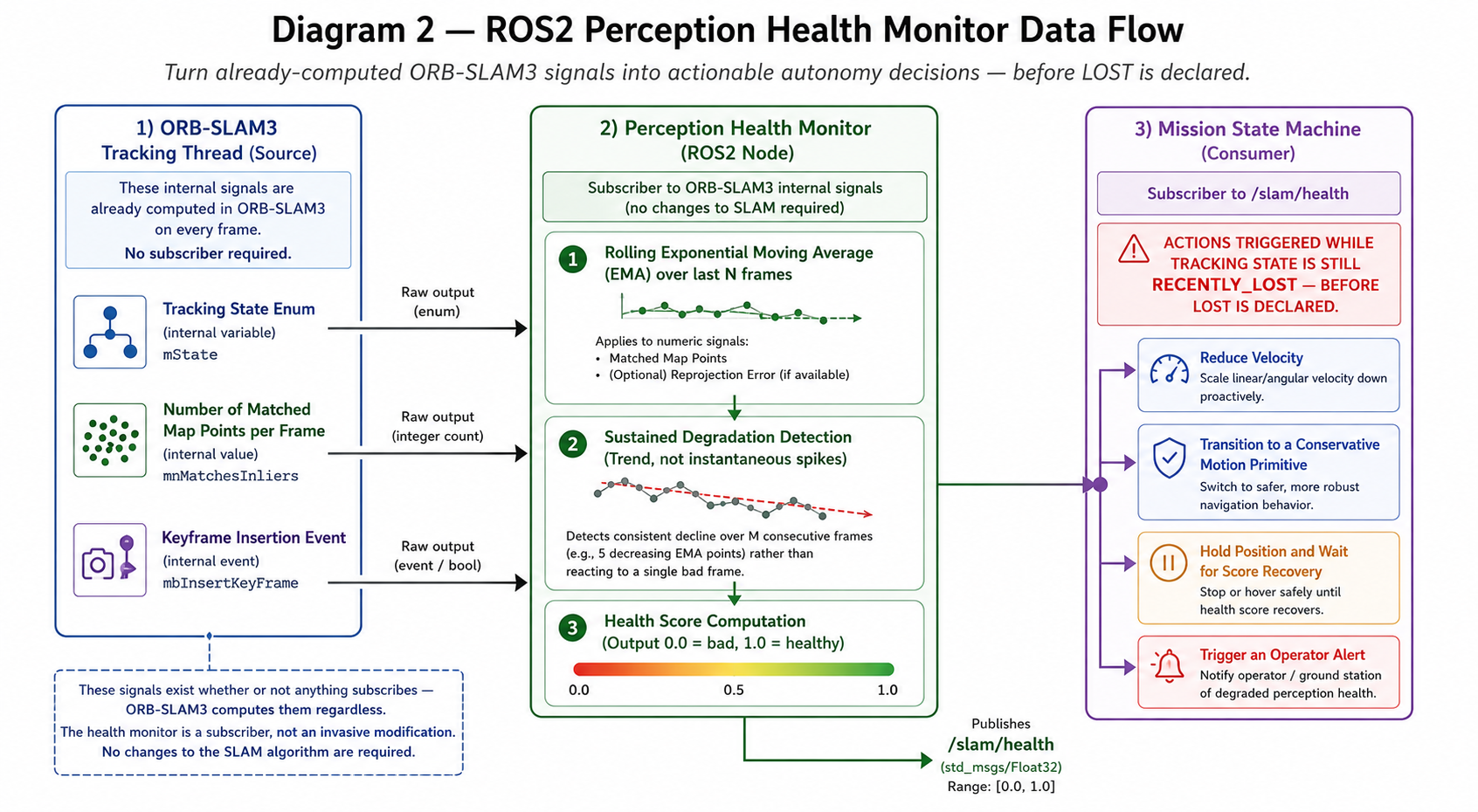
The score does not need to be a probability distribution. It does not need a neural network. A bounded exponential moving average over the last N frames, with thresholds calibrated during field testing, is sufficient to distinguish healthy operation from entering degraded mode from imminent failure. The key architectural decision is not the algorithm, it is where the output goes.
The autonomy stack needs to be listening. A health monitor that publishes to a topic nobody subscribes to is a dashboard, not a safety mechanism. The integration point that matters is between the health monitor and the behavioral layer—whatever governs the mission state machine. When the score degrades below threshold, the system should slow down, transition to a conservative motion primitive, signal the operator, or hold position. These decisions should happen before tracking is lost, not in response to it.
This is the embedded systems version of the question the introspective perception literature is asking. Not "how do we make SLAM more robust?" but "how does the system know when to stop trusting SLAM, and what does it do next?" The research answer involves learned error distributions and causal inference. The deployed answer is a 200-line ROS2 node, a topic, and a state machine transition.
If you are running ORB-SLAM3 on a Jetson, a Raspberry Pi, or any edge platform in a real deployment, there is a practical exercise worth doing before your next field test. Subscribe to the tracking state topic and log it alongside your mission timeline. Then replay the log after a run where something went wrong.
You will almost certainly find that the system was in RECENTLY_LOST for seconds before the failure event. The map point count was declining for frames before that. The signal was there. Nothing was reading it.
Building a perception health monitor is not a research contribution. It is an engineering discipline the field has not yet standardized. The research community is producing increasingly sophisticated tools for understanding perception failure after the fact. Embedded practitioners need simpler tools that act on it in real time, within the constraints that govern deployed systems.
SLAM is not silent when it is dying. We just have not built the habit of listening.
References
[1] Rabiee, S., & Biswas, J. (2020). IV-SLAM: Introspective vision for simultaneous localization and mapping. 4th Conference on Robot Learning (CoRL 2020). arXiv:2008.02760.
[2] Matthee, J., Uren, K. R., Van Schoor, G., & Van Daalen, C. (2024). Predicting the performance of ORB-SLAM3 on embedded platforms. South African Computer Journal, 36(2), 84–102. https://doi.org/10.18489/sacj.v36i2.20099
[3] Han, H., Taheri, M., Chung, S.-J., & Hadaegh, F. Y. (2025). A counterfactual reasoning framework for fault diagnosis in robot perception systems. arXiv:2509.18460.